NanoCarb space version: A compact interferometric spectrometer for greenhouse gas monitoring in the athmosphere
Published: August 3 / 2026
NanoCarb space version: A compact interferometric spectrometer for greenhouse gas monitoring in the athmosphere
Recently, we presented the NanoCarb instrument concept and we focused first on the instrument prototype, which was tested in SCARBOn airborne campaign (read more here). Now, it is time to look beyond and discuss more deeply on the NanoCarb space design which serve on a satellite platform to measure atmospheric CO₂ and CH₄ concentrations from orbit with high precision.
What began as an early concept in Horizon 2020 project SCARBO is steadily evolving into a well-defined space instrument with a clear path toward operational deployment. The development activities are jointĺy carried out by SCARBOn partners ONERA, Airbus‑F, Absolut System and UGA.
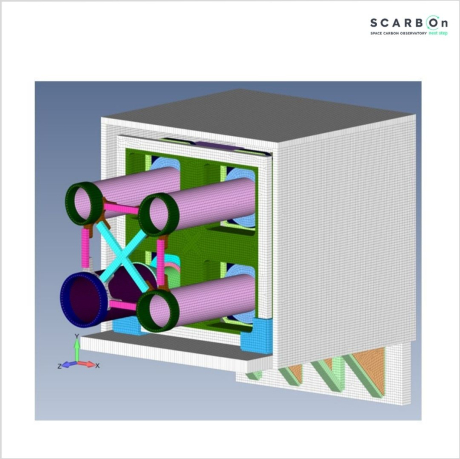
NanoCarb space instrument 3D view
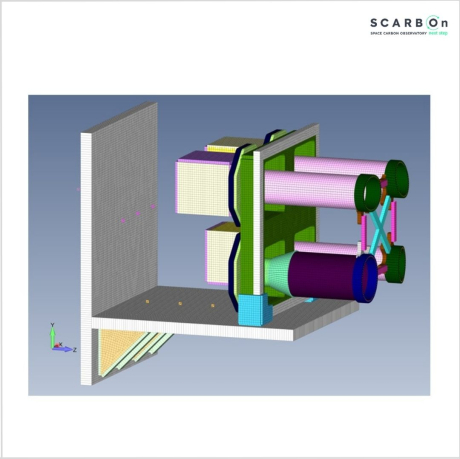
A four-channel architecture for greenhouse gas monitoring
NanoCarb space version design combines four spectral channels: two for CO₂, one for CH₄ and one for O₂.
To adapt the NanoCarb concept for space applications, the SCARBOn team (ONERA & Airbus):
- refined the key optical parameters for each spectral channel
- upgraded the design of the interferometric core
- designed the overall optical geometry
- sized the detection chain
- identified the most stable operating points
The first loop of end-to-end simulation permit to confirm the targetted performance.
Detectors: A decision that shapes the instrument
The choice of infrared detectors is a key factor in the instrument's performance. Detectors influence sensitivity, cooling requirements, and the overall instrument architecture. After evaluating different options, the SCARBOn team selected a detector configuration that offers a strong balance between performance, manufacturability, and cost. This is particularly essential consideration for future satellite constellations.
Refining the optical design
Significant progress occured also on the overall optical definition (ONERA and Airbus‑F). The optical layout of the each channel was refined, including the optimisation of the afocal telescope and microlens array, to achieve near diffraction-limited performance. Thermo-mechanical iterations, supported by Absolut System, helped adapt the design to the practical assembly constraints within the instrument.
Thermal control: Cooling the detectors
Maintaining a stable detector temperature is essential for achieving accurate greenhouse gas measurements. A detailed thermal model of the instrument (Absolut System) enabled the evaluation of cooling strategies and radiator sizing.
Preliminary structural analyses confirmed the robustness of the design and demonstrated its readiness for further optimisation in the next development phases.
Manufacturability
Finally, manufacturability studies (UGA-LTM and Airbus-F) confirmed that key components, such as the interferometric plate, coatings and detectors, can be realistically produced for future small‑series manufacturing. These results, helped by the assembly optimisation (Absolut System, Airbus-NL and Airbus-F) help ensure that NanoCarb instrument can move from a prototype to a scalable space instrument concept.
A consolidated definition of the NanoCarb space instrument
The optical design, detector selection, thermal engineering and manufacturability assessments activities now come together to achieve a consolidated design of the NanoCarb space instrument. This definition already serves as the reference for performance simulations and the development of the associated processing chain.
All these development step reached, NanoCarb instrument is becoming a more mature, scalable, and technically robust instrument concept capable of bringing high-precision greenhouse gas monitoring to a new generation of small satellite missions.
Stay connected with our latest updates on the SCARBOn LinkedIn profile: https://www.linkedin.com/company/scarbon-project