NanoCarb: the heart of the SCARBOn project
Published: April 14 / 2026
NanoCarb: the heart of the SCARBOn project
A brief look at the key technology behind SCARBOn
The NanoCarb instrument is the key enabler of the SCARBOn mission, providing measurements of greenhouse gas (GHG) concentrations in the atmosphere. It is designed for a future satellite mission that will deliver highly accurate, daily global observations of GHGs (particularly CO2) from space.
Why this matters
Measuring GHGs emissions through satellite monitoring helps to:
- Monitor key climate variables such as total column CO₂ and CH₄ - enabling scientists to monitor how concentrations evolve and better understand the drivers of global warming
- Provide independent emission data - strengthening transparency and supporting international climate commitments such as the Paris Agreement
- Identify emission hotspots (e.g., industrial sites, urban areas) - allowing for more targeted mitigation actions
- Support climate policy and decision-making - contributing to design of evidence-based strategies
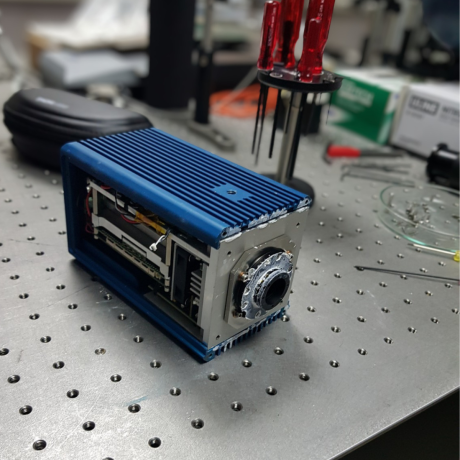
NanoCarb instrument, Source: SCARBOn consortium
Back to NanoCarb
The NanoCarb prototype instrument (developed by UGA and ONERA and improved by joint efforts with Absolut System) is designed to monitor CO₂ and CH4 emissions using a compact interferometric system that measures how light is absorbed by these gases.
This miniaturised imaging spectrometer, currently a prototype of about 15 x 4 x 4 cm3, is being tested and validated through an ongoing airborne campaign. But why is this necessary?
Before any satellite deployment, NanoCarb must move beyond laboratory conditions and validate in real conditions using a representative demonstrator.
From lab to sky: airborne validation
The current airborne campaign aims to validate NanoCarb early stage demontrator’s performance in CO2 and CH4 emission monitoring in the atmosphere, including its ability to monitor GHG from point sources (such as power plants).
After prototype assembly, characterisation tests made jointly by ONERA, UGA and Absolut System permitted to validate the prototype upgraded performance: from interferometric core (ONERA&UGA) to thermo-mechanical design (Absolut System).
Airborne measurements are complemented with on-ground observations of BIRA-ISAB, using an EM27/SUN FTIR spectrometer, kindly loaned by the Ruisdael Observatory. By comparing airborne and ground‑based data, the SCARBOn team can confirm the accuracy of NanoCarb performance and better understand CO₂ emission point sources detection.
Airborne campaigns are a critical bridge between laboratory prototypes and satellite missions. The data collected during this phase will support the next stages of the SCARBOn project, paving the way for future space‑based validation and eventual full satellite deployment.
Impatient to see the campaign results!
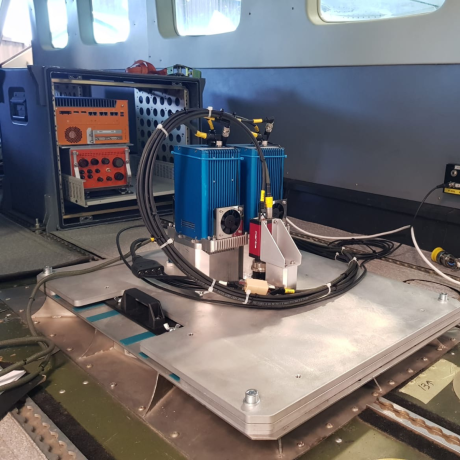
Installation of the NanoCarb instrument onboard the aircraft, Source: SCARBOn consortium