SCARBOn Airborne Campaign: Scientific Flight Completed
Published: April 23 / 2026
SCARBOn Airborne Campaign: Scientific Flight Completed
After weeks of preparation, technical coordination, prototype upgrades and testing, the SCARBOn team has completed the main objective of its airborne campaign: a scientific flight to test and refine the calibration of the NanoCarb prototype under real atmospheric conditions.
Mounted on a Cessna aircraft, managed by ICGC and supported by Airbus-ES for mechanical interface and flight certification, the NanoCarb prototype (a lightweight imaging spectrometer developed by UGA and ONERA and improved by joint engineering efforts with Absolut System) measured how light is absorbed by key greenhouse gases (GHGs): carbon dioxide (CO₂) and methane (CH₄). The ultimate aim is to obtain reliable CO2 and CH4 concentration mapping, enabling the monitoring of anthropogenic emissions.
Scientific Flight Objectives
The primary focus of the scientific flight was to validate NanoCarb’s capability to monitor GHG emitting point sources, particularly power plants. To achieve this, the mission combined three complementary sources of data:
SCARBOn aircraft lifting off for the scientific mission, Source: SCARBOn consortium
1. High-resolution spectral measurements from the onboard NanoCarb demonstration prototype
2. Wide-band spectral data acquired by a collateral onboard hyperspectral camera (FENIX camera)
3. Infrared spectral mesurements from an on-ground Fourier Transform Infrared (FTIR) instrument (EM27 loaned by the Ruisdael Observatory)
The scientific objectives of the campaign included:
- Assess instrument performance under operational flight conditions
- Collect high-quality data for the subsequent retrieval of GHG concentrations
- Demonstrate the technological readiness of NanoCarb-based solutions for monitoring emission point sources – including mapping the structure and dispersion of the CO₂ plume
- Support SCARBOn’s broader mission to develop reliable methods for monitoring anthropogenic emissions
Preparations and Flight Execution
Prior to takeoff, teams from DLR, ICGC and ONERA closely monitored weather conditions, wind directions and emission plume forecasting to ensure favourable validation conditions of clear sky and strong, measurable emission plumes as well as define and update flight planning.
The Cessna aircraft, with NanoCarb and hyperspectral camera onboard, operated from Mönchengladbach Airport with SCARBOn crew from ICGC and UGA.
During the pre-flight briefing, the SCARBOn team refined the flight legs to optimized plume interception, particularly in the early part of the day before the arrival of high-altitude clouds. Over the course of about 3 hours, the aircraft executed a series of precise flight legs across the emission plume. In parallel, the BIRA-IASB ground team collected reference measurements using an EM27/SUN FTIR spectrometer (kindly loaned by the Ruisdael Observatory) at three locations near the target area, ensuring robust cross-validation between airborne and ground-based observations.
All operative objectives were successfully completed.
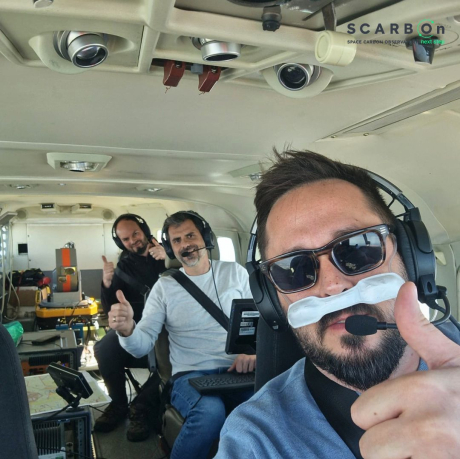
SCARBOn crew members on board, Source: SCARBOn consortium
Post-Flight: First Data Checks
The NanoCarb prototype generated approximately 400 GB of data, now undergoing processing and analysed at UGA, CNRS-LMD, DLR and ONERA.
Initial quality assessments indicate:
- Excellent data quality
- Stable NanoCarb instrument performance
- Good alignment between airborne and ground measurements
The successful completion of this scientific flight represents a major milestone for the SCARBOn project. The collected data will support the validation of innovative technologies designed to enhance greenhouse gas monitoring from space, ultimately contributing to more accurate quantification of anthropogenic emissions and evidence-based climate policy.
We look forward to sharing further insights as the data analysis progresses.
To be continued…
.jpg)
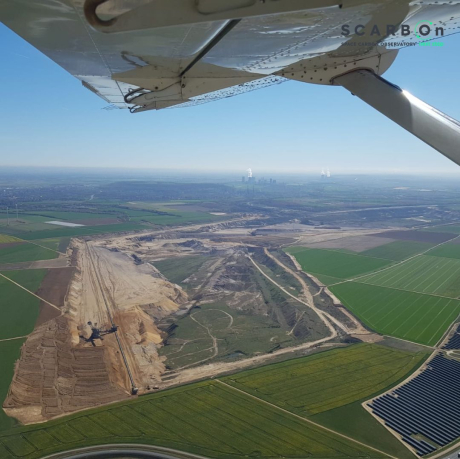
In‑flight data collection in progress, Source: SCARBOn consortium
.jpg)
NanoCarb CO2 and CH4 cameras ready on board, Source: SCARBOn consortium
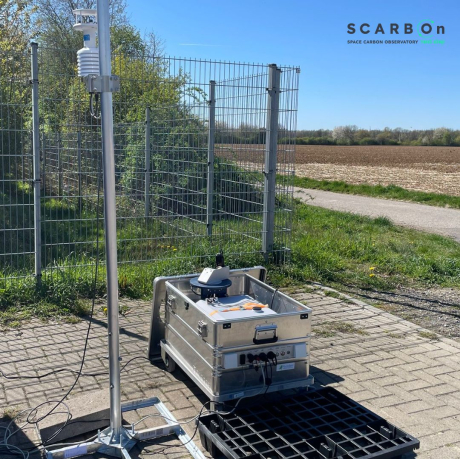
Groundbased FTIR spectrometer on site, Source: SCARBOn consortium