Two instruments, one clearer view: how SPEXone supports NanoCarb
Published: September 24 / 2026
Two instruments, one clearer view: how SPEXone supports NanoCarb
SCARBOn’s mission is to develop a conceptual formation of small satellites, that will provide sub-daily accurate measurements of GHG emissions (namely CO2 and CH4) in the Earth athmosphere. Such monitoring will be enabled by maturing the innovative miniaturised static spectrometer sensor NanoCarb along with accommodating the aerosol sensor SPEXone: an instrument developed by Airbus Netherlands B.V. and the Space Research Organisation Netherlands (SRON), supported by TNO.
SPEXone is a small, compact and technically advanced aerosol sensor which SCARBOn uses to sharpen its ability to interpret atmospheric GHG from orbit. Aerosols influence the light measured by NanoCarb sensors, and if we do not understand their impact well, they introduce biases into GHG estimates. This is exactly where the SPEXone instrument steps in and helps reduce these uncertainties. Recent SCARBOn findings show that using SPEXone together with NanoCarb reduces random errors in CO₂ estimates by roughly 25%, which means the combined measurements are more precise and more robust.

View of the SPEXone optomechanical assembly
What SPEXone Actually Is
The SPEXone instrument, developed by Airbus Netherlands B.V., is a Multi‑Angle Polarimeter (MAP) – an instrument that measures light from multiple viewing angles and captures its polarisation. This provides detailed information about aerosols: their amount, size, type, and how they scatter light. Today, SPEXone is flying on NASA’s PACE mission, where it delivers very accurate measurements of sunlight reflected from the atmosphere, land and ocean. These observations allow scientists to describe aerosols in much greater detail and are already helping improve climate‑related models and validate other satellite instruments.
Technically, SPEXone is a spectral‑modulation imaging spectropolarimeter, which means it:
- measures the spectrum and polarisation of light at the same time
- operates with no moving parts
- retrieves complete polarimetric information (degree and angle of linear polarisation) from a single shot
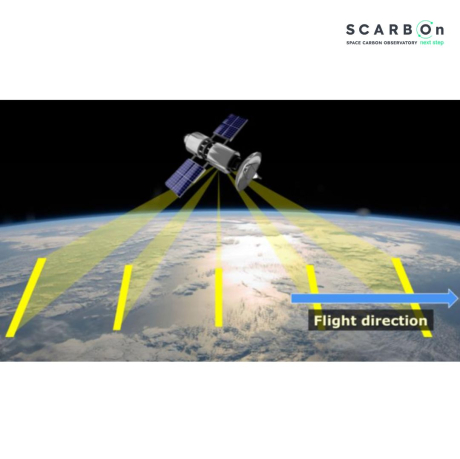
Schematic overview of SPEXone’s multi-viewing angle operation
Accommodation on the SCARBOn Platform
SPEXone has a modular design, so parts of the instrument (like the telescope or the swath width) can be easily adjusted. As a recent Airbus study confirmed, SPEXone instrument can be integrated into the SCARBOn mission without requiring major changes to the overall design. The instrument strengthens SCARBOn’s ability to monitor GHG more accurately. It is a key additional component to NanoCarb that helps ensure the mission delivers reliable, high‑quality atmospheric data for future European CO₂ monitoring missions.