NanoCarb: Instrument Design and Performance Validation Progress
Published: September 7 / 2026
NanoCarb: Instrument Design and Performance Validation Progress
The SCARBOn project and its emerging satellite mission are built around the NanoCarb space instrument, which is being developed to provide precise monitoring of atmospheric CO₂ and CH₄ concentrations from space.
Besides the refinement of the instrument design (see our previous article), the SCARBOn consortium deeply validates the NanoCarb concept (originally established in the preceding SCARBO project) through several key activities:
- Evaluating L2 and L4 data product performance
- Upgrading the instrument model if needed based on first data retrieval loop
- Defining the calibration strategy
- Establishing the first instrument specifications
These activities provide the technical foundation needed to mature the instrument and prepare it for a future satellite mission. Let’s take a closer look.
Improved performance assessment
The NanoCarb data processing chain, which converts Level 1 data (calibrated instrument measurements) into Level 2 products showing atmospheric CO2 and CH4 concentrations, was further improved by CNRS‑LMD. The updates include refinements to radiative transfer model and spectroscopy, leading to more accurate greenhouse gas retrievals.
This upgraded retrieval scheme has been applied to the latest NanoCarb instrument model to evaluate its performance. A first loop has been generated for the first NanoCarb design upgrade definition using more than 300 representative atmospheric scenes to quantify improvements in retrieval accuracy. Testing is currently underway for a second loop with the final optimised design of NanoCarb.
Looking closer at emission sources
SCARBOn is also assessing how these improvements translate into emission estimation at local scale. DLR is applying the updated instrument model to a simulated CO₂ plume from a large power plant and comparing the results with those obtained using the previous NanoCarb model.
The first results indicate noticeable improvements in the instrument´s capability to characterise local emission plumes. Stay tuned, more results coming soon.
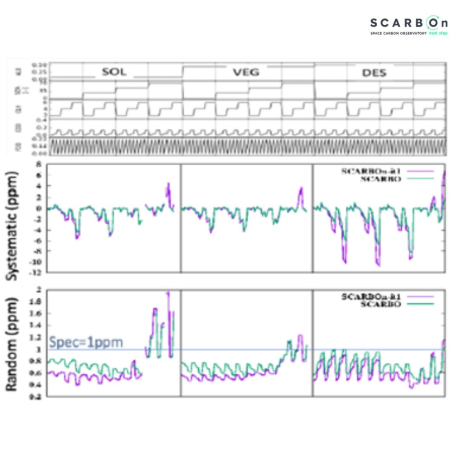
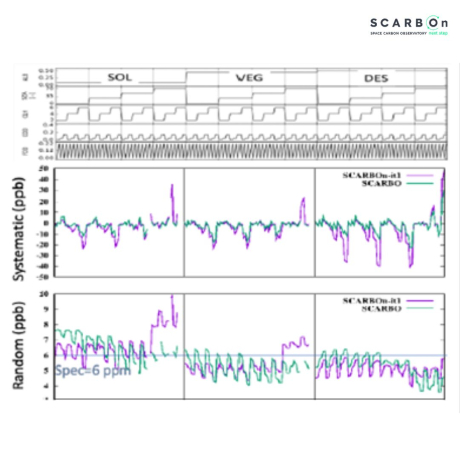
Systematic and random errors obtained for iteration 1 on CO2 (left) and CH4 (right) for the 324 situations analyzed and comparison with former SCARBO design
Instrument modelling and specifications
A NanoCarb space instrument simulator was further developed by Airbus, linked to the Level 2 performance and associated SNR criteria. It incorporates the latest optical improvements introduced by Airbus together with design updates provided by ONERA thanks to their MEDOC tool. The simulator reproduces realistic detector behaviour, optical performance and all known sources of measurement noise, and permits to perform sensitivity analyses as a support to specification.
Based on this work, ONERA generated detailed spectral response functions for every detector pixel and spectral band, as an input of the NanoCarb data processing chain.
Based on this enhanced model, the consortium established the first set of NanoCarb space instrument specifications – defining key technical requirements and expected performance parameters. These specifications will guide the instrument´s continued development and future validation activities.
Calibration strategy
In parallel, closely to the instrument specification, the first calibration strategy for the NanoCarb space instrument has been identified based on Airbus heritage. It aims to ensure accurate greenhouse gas measurements throughout the mission lifetime.
The strategy combines detailed pre‑launch characterisation with regular in‑orbit calibration activities. The team identified the main sources of measurement uncertainty, determined which parameters require calibration, and defined approaches for calibrating detector gain, offset, line of sight and optical response.
This calibration strategy can be further refined in coherence with the next outcomes of data retrieval performance and next instrument maturation.