SCARBOn: Review Meeting with HaDEA
Published: June 18 / 2026
SCARBOn: Review Meeting with HaDEA
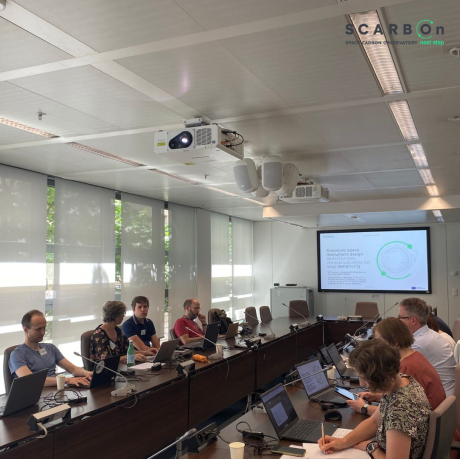
The SCARBOn consortium met in Brussels on 27th May for its third Formal Review Meeting with the Health and Digital Executive Agency (HaDEA) of the European Commission. HaDEA co-funds SCARBOn project towards its path to a small-satellites mission tracking greenhouse gas (GHG) emissions from space, more accurately and frequently than ever before.
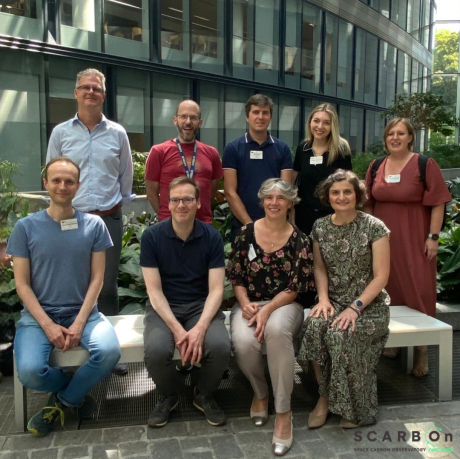
The meeting was hosted by HaDEA. All SCARBOn project partners assisted at the meeting (in-person or online), together with the SCARBOn HaDEA Project Adviser and an external expert. The objective was to review the progress achieved since autumn 2025 and to outline the next steps towards fulfilment of the project’s goals. The consortium presented a comprehensive set of updates across all implementation lines.
SCARBOn main achievements
SCARBOn work focuses on two parallel implementation axes:
- instrumental level: development of the NanoCarb instrument for precise GHG emission tracking
- satellite system level: definition of constellation architecture, encompassing satellite design, system budgets, and calibration strategies, while exploring autonomous and reconfigurable service opportunities
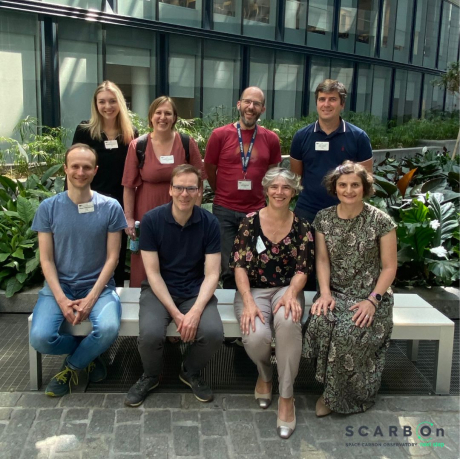
SCARBOn consortium
On the instrumental side, the NanoCarb prototype (two imaging spectrometer cameras) has undergone thermal design upgrades (Absolut System) and, most importantly, crucial upgrades of the interferometric core (ONERA& UGA) with more than doubling of its sensitivity!
After manufacturing and integration, the prototype was employed in an airborne campaign (coordinated by UGA, in close cooperation with ONERA, ICGC, BIRA‑IASB, and DLR) to test and refine its calibration under real atmospheric conditions in April 2026. All operational objectives were successfully achieved and several hundred GB of atmospheric monitoring data were collected for further processing and analysis by SCARBOn partners UGA, CNRS, DLR and BIRA‑IASB.
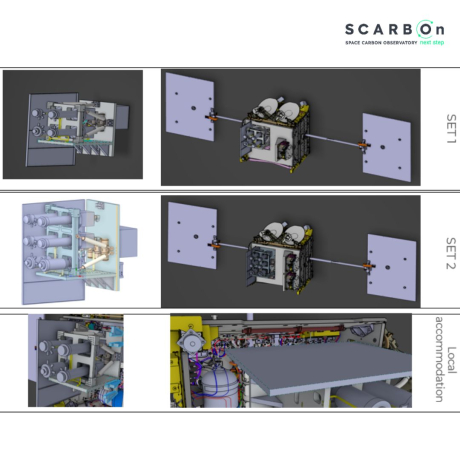
Visualisation of the NanoCarb accommodation on the Arrow platform as part of the satellite‑level design process
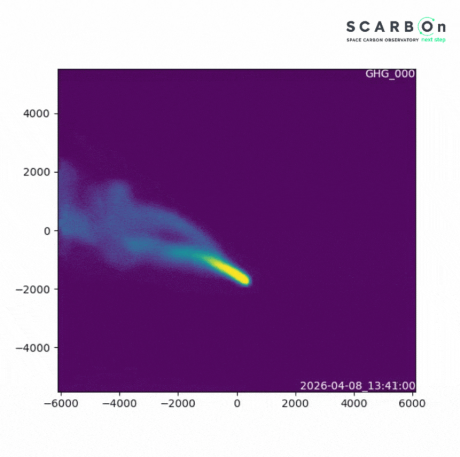
Snapshot from a simulation of the CO2 plume from the power plant during the airborne campaign
Enormous effort has been also invested in upgrades of the NanoCarb instrument destined for satellite space mission, which has been developed in parallel (by ONERA, Airbus, and Absolut System). NanoCarb space version design has been refined starting from each spectral channel definition, optical systems parameters definition (interferometric core upgrade, front-end focal optic design), detectors‘ selection, to its thermo-mechanical layout. Moreover, performance assessment and sensitivity analysis of the upgraded SCARBOn NanoCarb space version design has been produced by joint efforts of Airbus and CNRS, to support the ongoing specification work and mission maturation.
From the instrumental perspective, SCARBOn aims to use Airbus-NL compact aerosol sensor SPEXone within its satellite mission, to correct atmospheric scattering effects on precise GHG monitoring. SPEXone accommodation task was completed, confirming its compatibility as a compact, low‑power unit.
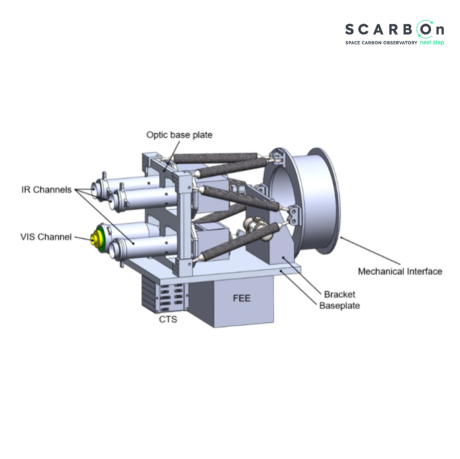
3D model of the NanoCarb space version design

SPEXone instrument
At the satellite system level, a key piece of work on the SCARBOn constellation architecture developed by Airbus-F (with inputs from Absolut System, Airbus-NL, CNRS, ONERA, UGA, and DLR) was presented, confirming the feasibility of achieving a satellite site revisit time of under one day: a feature that currently no other GHG satellite monitoring mission can offer!
Various platform configurations combining NanoCarb and SPEXone instruments were assessed, with calibration strategy and intercalibration offered with the CO2M synergy. Data downlink strategy, retrieval process and Tip&Cue cases were further developed. SCARBOn industrialisation planning continues to focus on efficient serial production from instrument to constellation level.
SCARBOn up-to-date achievements were acknowledged by the reviewers: preliminary feedback recognized the strong progress made to date and the depth of the technical content presented, while offering guidance to support the next phase of the project.
Mission impact
All SCARBOn effort has been produced with the aim to provide substantial contributions to the EU’s climate and environmental policy priorities in the areas of GHG monitoring, emission verification and climate mitigation strategies. SCARBOn mission target to support evidence-based policymaking by providing independent and verifiable data streams that can complement existing ground-based systems and the Copernicus programme.
The project’s scalable, cost-effective satellite systems could inform new support schemes, incentivizing the adoption of advanced climate technologies across industries and contributing to the EU’s strategic autonomy in space-based environmental monitoring.
SCARBOn project gratefully acknowledge the funding support from HaDEA, which makes all this presented work possible and contributes to advancing Europe’s next‑generation GHG monitoring technologies.